Savannah history
From Yamacraw Bluff to today
1733: Oglethorpe, Tomochichi and the Yamacraw
Georgia received its charter from King George II in 1732, the last of England's thirteen American colonies. James Edward Oglethorpe sailed with 114 colonists on the Anne, and on February 12, 1733 they landed at Yamacraw Bluff on the Savannah River, about fifteen miles from the ocean.
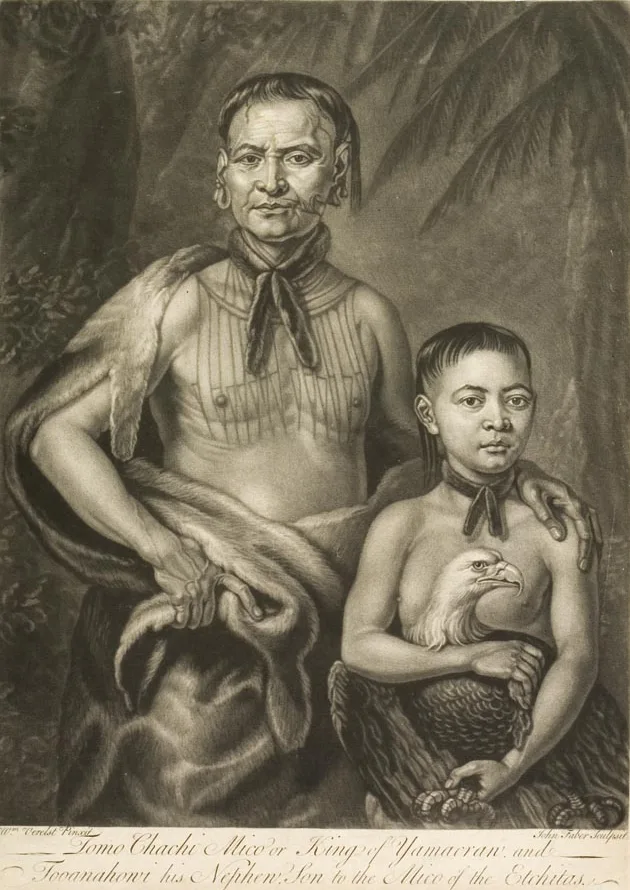
Oglethorpe established cordial relations with Tomochichi, the leader (mico) of the Yamacraw people living at the bluff, helped by the trader and interpreter Mary Musgrove. Tomochichi travelled to England with Oglethorpe in 1734, where the portrait below was painted.
The Trustees planned Georgia as a philanthropic colony of small farmers. Slavery was banned at first; the ban was lifted in 1750. Savannah drew a remarkably diverse population early on: Jewish settlers arrived in 1733 and founded Congregation Mickve Israel, followed by Salzburgers, Scottish Highlanders, Moravians and others. George Whitefield founded Bethesda, colonial America's first orphanage.
The Oglethorpe plan: wards and squares
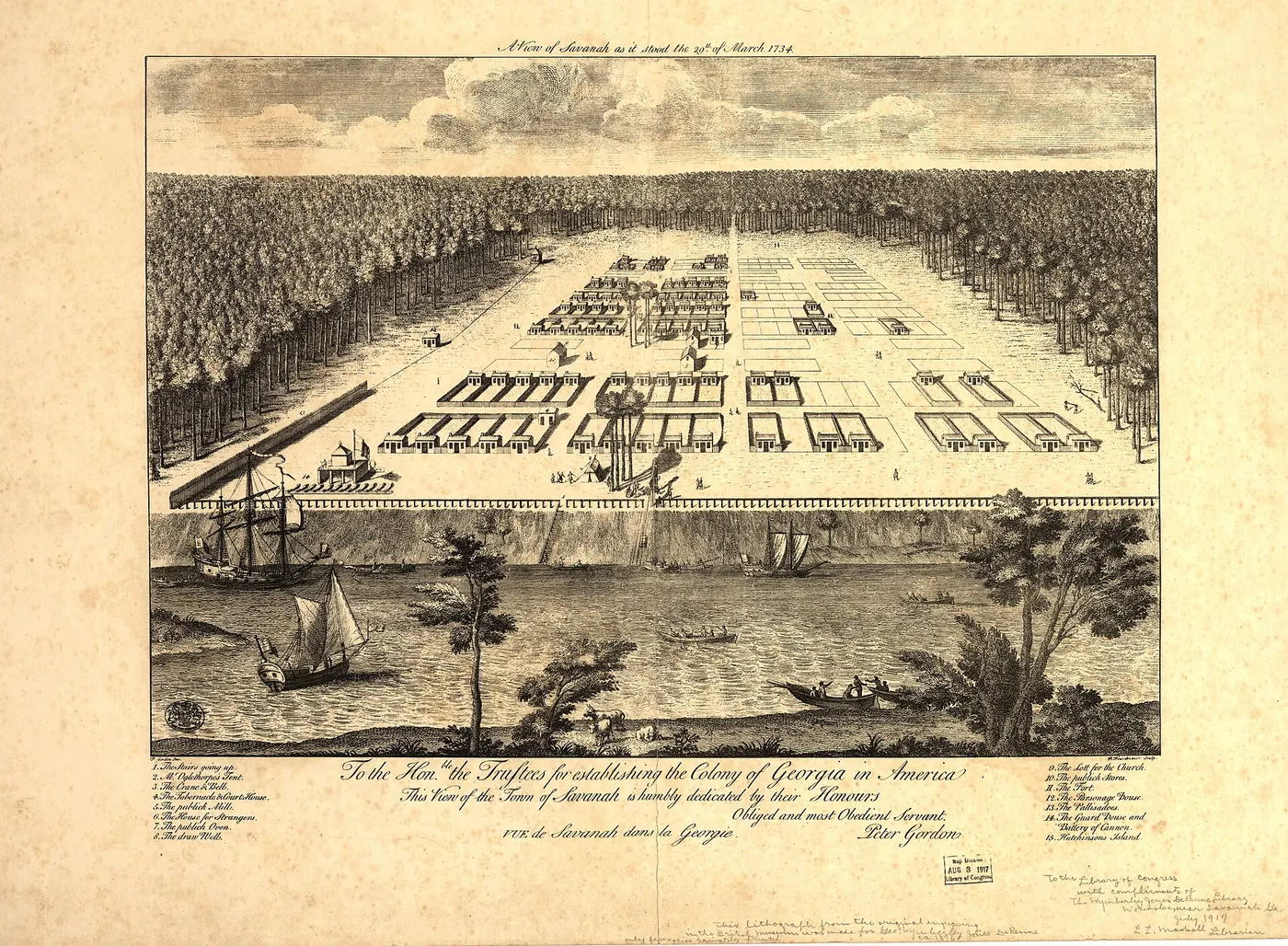
Oglethorpe and his co-planner, William Bull of South Carolina, laid the town out in wards built around central squares, with “trust lots” on the east and west sides for public buildings and churches and “tything lots” for homes on the north and south. The National Park Service calls Savannah “America's first planned city”: it grew to 24 squares, and 22 survive today, such as Johnson Square, Wright Square, Reynolds Square and Chippewa Square.
The Revolution and the Siege of Savannah
The Liberty Boys, Savannah's independence men, met at Tondee's Tavern. British forces captured the city in 1778. In October 1779 a combined American and French force under General Benjamin Lincoln and Count d'Estaing tried to retake it and was driven back, in one of the bloodiest battles of the war. Sergeant William Jasper and Count Casimir Pulaski were both killed in the assault. The site is remembered at Spring Hill Redoubt.
After independence Savannah was Georgia's first capital (until 1786), and George Washington visited in 1791.
Cotton, rice and the port
In 1793, at Mulberry Grove plantation near Savannah, Eli Whitney perfected a working cotton gin. Antebellum Savannah was built on slavery and on cotton and rice, and became one of the world's leading cotton ports; cotton prices were long set at the Cotton Exchange on Bay Street. In 1819 the S.S. Savannah sailed from here as the first steamship to cross the Atlantic from the United States.
The city also suffered: fires in 1796 and 1820 each left about half of it in ruins, and yellow fever killed more than 700 people in 1820 and about 1,000 in 1854. Forsyth Park was laid out in 1851 and got its famous fountain in 1858.
Slavery, freedom and Black Savannah
First African Baptist Church traces its organization to 1773 under the Rev. George Leile, which makes it older than the United States; its present sanctuary was completed in 1859, and its balcony pews were made by enslaved people. Second African Baptist Church on Greene Square was founded in 1802.
In 1860 Savannah had 7,712 enslaved residents and 705 free Black residents. On January 12, 1865, General Sherman and Secretary of War Stanton met 20 leaders of Savannah's Black churches at the Charles Green house, now the Green-Meldrim House. Four days later Sherman issued Special Field Orders No. 15, setting aside coastal land for freed families in 40-acre tracts. On February 3, 1865, General Rufus Saxton explained the order to freedpeople at Second African Baptist. President Andrew Johnson later revoked it.
In the 1950s and 1960s Savannah's nonviolent civil rights campaign was led by figures such as Ralph Mark Gilbert and W. W. Law; learn more at the Ralph Mark Gilbert Civil Rights Museum, the Beach Institute and the African-American Monument on River Street.
The Civil War and Sherman's “Christmas gift”
Confederate forces seized Fort Pulaski early in 1861; Union rifled cannon forced its surrender in April 1862, and the port was blockaded for the rest of the war. Sherman's March to the Sea ended here. On December 22, 1864 he telegraphed President Lincoln, presenting “as a Christmas gift, the City of Savannah with 150 heavy guns and plenty of ammunition; and also about 25,000 bales of cotton.” The city was spared destruction.
1955: the preservation movement
By the early 1950s Savannah was called a “pretty woman with a dirty face,” and historic buildings were being torn down. In 1955 a group of Savannah women led by Anna C. Hunter saved the 1820 Davenport House from demolition. That effort became the Historic Savannah Foundation, which has since saved many buildings in the historic district. The district was designated a National Historic Landmark in 1966.
Along the river stands the Waving Girl. Florence Martus (1868–1943), who lived on the river with her brother, a light keeper, waved a cloth by day and a lantern by night at every passing ship for more than 44 years, according to the National Park Service. Ships answered with their whistles.
SCAD and Savannah today
The Savannah College of Art and Design (SCAD) was founded in 1979; its students and faculty have helped restore many of the city's historic buildings (see the SCAD Museum of Art, built around an 1853 railway depot). John Berendt's Midnight in the Garden of Good and Evil brought new visitors in the 1990s, and tourism is now the city's leading industry, alongside one of the busiest container ports in the country.
Timeline
- 1733Oglethorpe's colonists land at Yamacraw Bluff (Feb 12)
- 1733Jewish settlers arrive; Mickve Israel founded
- 1750Georgia's ban on slavery lifted
- 1773First African Baptist Church organized
- 1778British capture Savannah
- 1779Siege of Savannah fails (October)
- 1793Whitney's cotton gin at Mulberry Grove
- 1802Second African Baptist Church founded
- 1819S.S. Savannah crosses the Atlantic
- 1820Great fire and yellow fever epidemic
- 1858Forsyth Park fountain installed
- 1862Fort Pulaski falls to Union rifled cannon
- 1864Sherman's “Christmas gift” telegram (Dec 22)
- 1865Special Field Orders No. 15 (Jan 16)
- 1955Davenport House saved; Historic Savannah Foundation begins
- 1966Historic district named a National Historic Landmark
- 1979SCAD founded
Sources
- New Georgia Encyclopedia: Savannah (Buddy Sullivan)
- National Park Service, Fort Pulaski: Savannah
- National Park Service: Florence Martus
- New Georgia Encyclopedia: Savannah City Plan
- First African Baptist Church: History
- Georgia Historical Society marker: Special Field Orders No. 15
- Historical marker: Second Baptist Church (City of Savannah, 1976)
- Historic Savannah Foundation